
Grain Fundamentals
Emmer Wheat: Origins, Resilience, and Why Foundational Grains Still Matter
Emmer wheat is one of the earliest cultivated cereals and a foundational grain in the history of agriculture. Long before modern bread wheat existed, emmer supported early farming societies across the Fertile Crescent, North Africa, and Europe, shaping both food systems and the domestication of wheat itself.
Unlike modern wheat varieties developed through formal breeding programs and industrial farming systems, emmer reflects the long, gradual process of domestication. Its hulled grain structure, agronomic traits, and genetic profile preserve important clues about how wheat was first selected, grown, and adapted to place.
This article explores what emmer wheat is, where it comes from, how it shaped the evolution of modern wheat, and why understanding emmer helps explain the importance of diversity, place, and resilience in our food system.

One of the First Domesticated Cereals
Emmer wheat was among the first cereals deliberately cultivated by early farming communities. Archaeobotanical and genetic evidence places its domestication in the early Neolithic period, when human societies began transitioning from hunting and gathering to settled agriculture.
Early domestication focused on practical traits that improved harvest reliability and storage. One of the most important was the shift from shattering to non shattering seed heads, allowing grain to remain attached during harvest. These early selection pressures shaped emmer into a dependable crop well suited to hand harvesting and small scale farming systems.
From its origins in the Fertile Crescent, emmer spread widely with the expansion of agriculture. For thousands of years, it was not a marginal grain but a central one, forming the basis of diets across regions that would later become known for wheat culture.
From Wild Emmer to Cultivated Fields
Emmer was domesticated from wild emmer wheat, a grass species still found growing in parts of the eastern Mediterranean. This transition was not a single event, but a gradual process shaped by repeated cycles of planting, harvesting, and selection.
As emmer moved into new regions, it adapted to local environments. Climate, soil type, rainfall patterns, and farming practices influenced how the grain expressed itself. Over time, distinct regional forms of emmer emerged, each shaped by place rather than by standardisation.
This close relationship between grain and environment is one of emmer’s defining features. Rather than being bred to perform uniformly across landscapes, emmer evolved through interaction with specific growing conditions.
Emmer Wheat: Quick Facts
Also known as: Farro medio (Italy), Khapli wheat (India), hulled wheat
Botanical classification: Triticum turgidum ssp. dicoccon
Wheat type: Tetraploid wheat (28 chromosomes), sitting between einkorn (14 chromosomes) and modern bread wheat (42 chromosomes)
Domestication: Among the earliest domesticated cereals, approximately 10,000 years ago
Origin: Fertile Crescent, particularly the Levant and south eastern Anatolia
Kernel characteristics: Medium sized, tightly hulled kernels requiring dehulling after harvest. The hull provides a natural protective barrier against pests and moisture
Typical flavour profile: Rich, nutty, slightly earthy
Agronomic traits: Tall plants, lower yields than modern wheat, strong adaptation to marginal soils
Gluten content: Contains gluten. Not suitable for people with coeliac disease
Common uses: Whole grain, cracked grain, flour for flatbreads, porridge, pasta, and traditional breads
Harvest time: August/October (Central QLD), November/December (NSW), December (Victoria)
Emmer’s Genetic Legacy in Modern Wheat
Emmer occupies a central position in wheat evolution. At a genetic level, it sits between einkorn and modern bread wheat. Einkorn carries 14 chromosomes, while modern bread wheat carries 42. Emmer, as a tetraploid wheat with 28 chromosomes, occupies a middle position in this progression. This genetic structure helps explain how wheat evolved not as a single leap, but through successive expansions shaped by domestication and human selection.It is the direct ancestor of durum wheat and contributed genetic material to the development of modern bread wheat.
Early hybridisation between wild einkorn and a wild goatgrass contributed to the formation of wild emmer, a tetraploid wheat carrying two sets of chromosomes from each parent. Through domestication, emmer became a cultivated staple and later gave rise to durum wheat through selection for free-threshing traits. A further hybridisation event involving tetraploid wheat and another wild goatgrass led to the development of hexaploid wheats, including spelt and, later, modern bread wheat. As the diagram to the right shows, rather than a single linear progression, wheat evolution is a branching process shaped by genetics, environment, and human selection, with emmer occupying a central and formative role.
Understanding emmer helps explain why modern wheat behaves the way it does. Many traits now taken for granted, including kernel size, protein expression, and gluten structure, have their roots in early domesticated wheats like emmer. At the same time, the narrowing of genetic diversity through later breeding has moved modern wheat further from this broader genetic base.
Emmer therefore represents both continuity and contrast. It links modern wheat to its origins while highlighting how far contemporary varieties have diverged from early forms shaped by place and necessity rather than yield optimisation.

Farming Characteristics and Agronomy

Emmer wheat is well adapted to low input agricultural systems. It performs reliably in poorer soils and under variable climatic conditions, traits that made it valuable to early farmers and remain relevant today.
Compared with modern wheat, emmer typically produces lower yields and fewer tillers. Plants are often taller and less responsive to high fertiliser inputs. These characteristics reflect pre industrial farming priorities, where reliability and resilience mattered more than maximising output.
For farmers interested in diversification or working with traditional cropping systems, emmer offers a grain that aligns with long term soil health rather than short term yield targets.
Modern growers continue to see these traits play out in practice. While emmer is not a high-yielding crop and requires additional processing due to its hulled grain, it has proven exceptionally resilient in dry conditions. In western New South Wales, emmer has demonstrated a capacity to produce reliable harvests in drought years where other traditional wheats struggle, reinforcing its reputation as a grain shaped by resilience rather than yield optimisation.

Processing, Hulling, and Milling
One of emmer’s defining features is its hulled grain structure. After harvest, the kernels remain tightly enclosed within the husk and require mechanical dehulling before milling or cooking; which can reduce the weight of the harvested grain by as much as 50%.
This additional processing step contributed to emmer’s decline as agriculture became mechanised and labour costs increased. Free threshing wheats, which release their grain easily during harvest, became more attractive in industrial systems.
Once dehulled, emmer can be milled using both stone and roller milling methods. Wholemeal flours tend to retain a slightly coarser texture and strong grain character, while roller milling allows for greater control over particle size and flour consistency. Each approach highlights different aspects of the grain.
Flavour, Dough Behaviour, and Use
Emmer flour behaves differently to modern bread wheat flour. While it often has relatively high protein content, its gluten structure is gentler and less elastic. Doughs made with emmer tend to be softer and more extensible, responding best to careful handling and longer fermentation.
Rather than being pushed to achieve high volume loaves, emmer performs well in applications where flavour and texture are prioritised over lift. Traditional breads, flatbreads, porridge, pasta, and cracked grain dishes all allow emmer’s character to come through clearly.
These uses reflect how emmer has historically been prepared and consumed, long before modern baking expectations took hold.

Nutrition, Digestibility, and Context
From a nutritional perspective, emmer wheat is comparable to other whole grains. It contains carbohydrates, protein, fibre, and a range of naturally occurring micronutrients. Interest in emmer often arises alongside broader conversations about traditional grains and modern diets.
As with all wheat, emmer contains gluten and is not suitable for people with coeliac disease. Responses to wheat foods vary between individuals and are influenced by many factors, including grain type, processing, fermentation, and overall diet. We go into this in a bit more detail in our article about gluten.
Rather than positioning emmer as a solution, it is more accurate to view it as part of a wider landscape of grain diversity. Understanding how different wheats behave helps move the conversation beyond simple categories and toward more informed choices.
Why Emmer Wheat Still Matters Today
Emmer wheat matters because it sits at the foundation of wheat agriculture. Its history helps explain how wheat was domesticated, how diversity emerged, and how modern systems narrowed that diversity over time.
Keeping emmer in cultivation supports genetic diversity within wheat itself. This diversity underpins resilience, flavour, and adaptability, particularly as farming faces increasing environmental uncertainty.
Emmer also reinforces the importance of place. Even with the same genetics, how a grain grows, mills, and tastes is shaped by environment and farming practice. Working with emmer means accepting variation as part of the process rather than something to be eliminated.
For us, offering emmer is not about reviving the past or promoting novelty. It is about recognising the value of grains that helped build agriculture in the first place, and understanding why maintaining diversity remains relevant today.
FAQs about Emmer
No. While both are ancient wheats, emmer and spelt are genetically distinct and behave differently in the kitchen.
Emmer is a tetraploid wheat with 28 chromosomes, while spelt is a hexaploid wheat with 42 chromosomes, the same number as modern bread wheat. This difference affects how their proteins and gluten structures form during mixing and fermentation.
In baking, emmer tends to produce softer, less elastic doughs that are best suited to flatbreads, traditional loaves, pasta, and blended flours where flavour is the priority. Spelt, by contrast, usually develops a stronger gluten network and is more capable of producing lighter, higher-rising loaves on its own, though it still behaves differently to modern bread wheat.
Flavour is another point of distinction. Emmer is often described as rich, nutty, and earthy, with a depth that works well in savoury applications. Spelt typically has a milder, slightly sweet flavour and a lighter texture in baked goods.
Yes. Emmer contains gluten and is not suitable for people with coeliac disease. However, some people are more able digest emmer than they would modern wheat. We discuss a bit more about gluten and digestibility in our gluten article, which you can read here.
Yes. Many describe it as nuttier and richer than standard wheat flours.
Saying that emmer is a hulled wheat means that after harvest, the grain remains tightly enclosed in a protective husk. Unlike free-threshing wheats, where the grain separates easily from the husk during harvesting, emmer requires an additional dehulling step before it can be milled or cooked.
This hulled structure was an advantage in early farming systems. The husk helped protect the grain from pests, moisture, and damage during storage, making emmer a reliable crop for early agricultural societies. In modern farming, however, the extra processing step adds time and cost, which is one reason hulled wheats declined as agriculture became more mechanised.
Being hulled also influences how emmer behaves as a grain. It often retains a strong grain character and is well suited to wholegrain uses, traditional milling, and longer fermentation processes. Rather than a flaw, the hulled nature of emmer reflects the agricultural context in which it evolved and the priorities of the systems that once depended on it.
Yes, but it behaves differently to modern bread wheat. It is best suited to traditional breads, flatbreads, and longer fermentations, or blending with either a modern or strong heritage wheat.
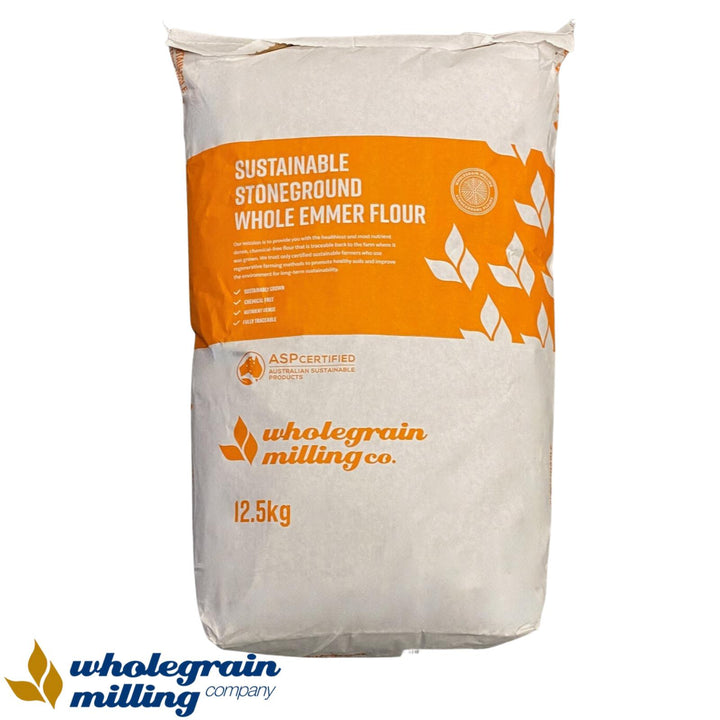
Emmer Products




Glossary
Hulled wheat
A wheat type where the grain remains enclosed in a husk after harvest and requires dehulling before milling.
Non shattering
A domestication trait where grains remain attached to the seed head during harvest.
Tillering / Tillers
The process by which a wheat plant produces additional shoots from its base. Each tiller can produce a grain-bearing head. Varieties that tiller heavily often produce higher yields, while low-tillering types tend to produce fewer but larger kernels.
Polyploidy
A natural genetic feature where a plant carries more than two sets of chromosomes. Different wheat species have different levels of polyploidy, which affects how they grow, how their grain behaves and often how it is digested.
Tetraploid wheat
A type of wheat with four sets of chromosomes. Khorasan, emmer, and durum wheats fall into this group. Tetraploid wheats often have larger kernels and different gluten characteristics compared with modern bread wheat.
Hexaploid wheat
A type of wheat with six sets of chromosomes. Most modern bread wheats are hexaploid, a feature linked to strong gluten and suitability for industrial baking.
Free-threshing wheat
A wheat type where the grain separates easily from the husk during harvest and threshing. Free-threshing wheats became dominant as agriculture mechanised because they reduced labour and processing time. Most modern bread wheats are free-threshing, whereas older wheats such as emmer are hulled and require dehulling after harvest.
Low-input farming
Farming systems that rely less on synthetic fertilisers and chemicals, often emphasising crop rotations, soil health, and resilience over maximum yield.
Vitreousness
A term describing the hard, glassy appearance of some wheat kernels. High vitreousness often affects how grain mills and how flour behaves in dough.