


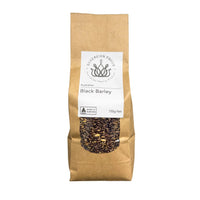
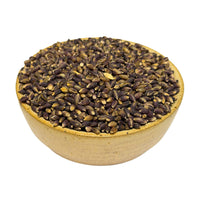
An ancient hull-less heirloom barley, grown in Australia by Chris and Sam Greenwood at Coleambally, NSW. Ethiopian Black Barley is distinguished by its naturally dark grain and its long history as a food crop.
Unlike most modern barley, its hull separates readily from the kernel, making the whole grain particularly well suited to cooking and home milling.
About Ethiopian Black Barley
A note about this grain: As a minimally processed, hull-less whole grain, you may occasionally find small pieces of chaff amongst the barley. The grain has been cleaned, but some light harvest material can remain. We recommend giving the grain a quick visual check before cooking or milling.
Ethiopian Black Barley is an ancient heirloom grain with a history stretching back thousands of years. Common searches trace the variety to around 4500 BC and describe it as having historically been an important food grain across parts of North Africa, the Middle East and the Himalayas.
What makes this barley particularly interesting to us is that it is hull-less.
Most barley has a tough hull that remains tightly attached to the kernel after harvest and needs to be mechanically removed before the grain is eaten. Hull-less barley is different. Its hull is naturally loose and separates readily during harvesting and handling, leaving the grain intact without requiring the same degree of processing.
That makes Ethiopian Black Barley particularly interesting as a whole food grain. It can be cooked whole or milled directly into wholegrain flour, retaining the parts of the kernel that can otherwise be removed when barley is pearled.
Its naturally dark colour is another distinctive characteristic of the variety rather than the result of roasting or processing.
Grown by Chris & Sam Greenwood
This Ethiopian Black Barley is grown by Chris and Sam Greenwood at Coleambally in the Riverina region of NSW.
The Greenwoods also grow other grains supplied through Voyager Craft Malt, which is how we first came across this unusual barley.
The current crop was sown in May 2025 and harvested in November. A dry spring finish resulted in modest yields and a somewhat smaller grain, another reminder that grain is an agricultural product and each season leaves its mark on the harvest.
What Does ‘In Conversion’ Mean?
This particular crop comes from a newer parcel of land on Chris and Sam's farm that is currently in conversion.
Conversion is the transition period during which land is being managed towards organic or biodynamic certification but has not yet completed the required certification period.
We think crops grown during this period deserve a market too. Transitioning additional land takes time, and supporting growers through that process helps make it possible for more Australian farmland to move into certified organic and biodynamic production.
For that reason, we identify this grain as In Conversion rather than describing it as certified organic or biodynamic.
Why We Love It
- Ancient heirloom barley with origins stretching back thousands of years
- Hull-less, making it particularly suited to eating and home milling
- Naturally dark grain
- Australian grown by Chris and Sam Greenwood at Coleambally, NSW
- Current crop tests at 13.2% protein
- Can be cooked whole or freshly milled into flour
- Grown on land currently in conversion
-
An opportunity to support an Australian grower while additional farmland moves through the conversion process
Cooking & Milling
Cooking Whole
Ethiopian Black Barley can be cooked and used much like other whole barley grains. Its firm texture makes it suitable for soups, salads, grain bowls and other dishes where you want the barley kernel to remain a distinct part of the dish.
Because this is a whole, hull-less grain rather than pearled barley, cooking times will be longer. Soaking before cooking can help reduce the cooking time.
Milling into Flour
The grain can also be freshly milled into wholegrain barley flour.
Barley behaves quite differently from bread wheat. It does not have the same gluten-forming ability, so using increasing amounts in a wheat-based bread will change the structure and texture of the dough.
Rather than thinking of it as a direct replacement for bread wheat, experiment by blending freshly milled barley flour with wheat flour and adjusting the proportion according to the flavour, colour and texture you want.
It can also be explored in biscuits, crackers, flatbreads and other baking where strong gluten development is less important.
Additional Product Information
Grain: Barley
Variety: Ethiopian Black Barley
Type: Hull-less heirloom barley
Growers: Chris and Sam Greenwood
Growing Region: Coleambally, NSW
Growing Status: In Conversion
Harvest: November 2025
Protein: 13.2%
Country of Origin: Australia
Agricultural products naturally vary between seasons. Protein, grain size and other characteristics may change from one harvest to the next.
FAQs
Why is it called Ethiopian Black Barley?
The name refers to the grain's historical association with Ethiopia and its naturally dark kernel. The grain itself is now grown in Australia by Chris and Sam Greenwood at Coleambally, NSW.
Is Ethiopian Black Barley actually black?
The grain is naturally darkly pigmented, although individual kernels and harvests can vary in colour. The colour is a characteristic of the grain itself and is not created by roasting.
What does hull-less barley mean?
Most barley has a tough outer hull that remains attached to the kernel after harvest and needs to be removed before eating.
In hull-less barley, the hull is much more loosely attached and separates readily during harvesting and handling. This makes the intact grain particularly suitable for food and home milling without first having to pearl it.
Is hull-less the same as pearled barley?
No.
Hull-less describes a characteristic of the barley itself. Pearling is a processing method where the outer layers of a barley kernel are mechanically abraded away.
Our Ethiopian Black Barley is supplied as an intact whole grain rather than pearled barley.
Can I mill it in a home grain mill?
Yes. Its hull-less nature is one of the reasons we were particularly interested in this grain. It can be milled directly into wholegrain barley flour using a suitable home grain mill.
Can I make bread with Ethiopian Black Barley?
Yes, but barley behaves differently from bread wheat and does not provide the same gluten structure.
For conventional risen bread, we recommend experimenting with it as part of a blend with wheat flour rather than treating it as a direct one-for-one replacement. The proportion can then be adjusted over successive bakes according to the flavour, colour and texture you prefer.
Is this grain organic or biodynamic?
This particular crop is in conversion, rather than certified organic or biodynamic.
It is grown on a newer parcel of Chris and Sam Greenwood's farm that is progressing through the conversion process. We identify it separately so its current status is clear.
Where did you find this grain?
We discovered Ethiopian Black Barley through a conversation we had with Stu at Voyager Craft Malt while looking for Australian grown grains and malts.
Voyager works directly with Australian grain growers, including Chris and Sam Greenwood, and has helped connect us with some unusual grains that would otherwise be difficult for a small food business like ours to access.
Product repacked by Sovereign Foods in compostable bags.
Our Bags are made from brown recycled paper and have a 100% natural corn-based compostable biofilm. All you need to do is pop off the label before you put it in your compost (We are looking for a cost-effective compostable solution to our labels). These bags are a good short term but are not completely airtight. When you get your goodies home, be sure to pop your products into a jar and store them in a cool, dry place out of sunlight. You can reuse these bags around the house as a short-term solution to keep things dry and reduce air contact.
Weight:
Dimensions: x x
Product contains Gluten and packed in a facility that stores and packs products that contain Nuts and Soy
Growing Methods:

